
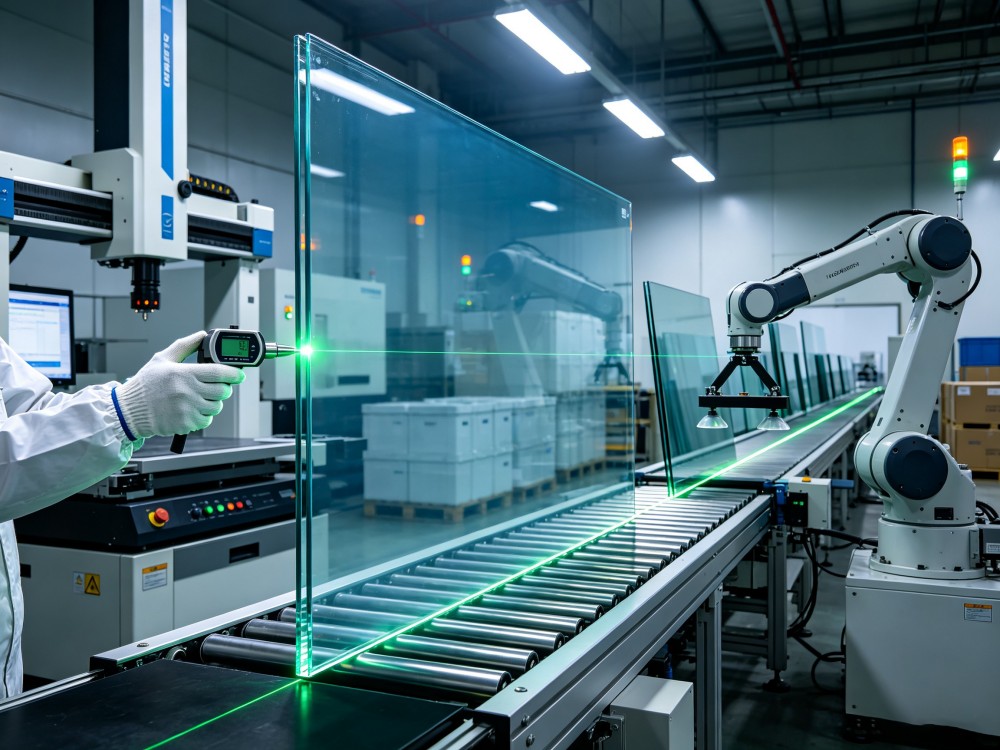
Achieving precision glass panel production with fast lead times requires integrated in-house capabilities. Discover how automated lines and stringent quality control deliver ±0.5mm tolerance and 250,000–300,000 pieces monthly capacity for appliance manufacturers worldwide. Contact us for your custom glass solution today.
The Precision–Speed Dilemma in Appliance Glass Manufacturing
Every appliance manufacturer knows the tension. You need glass panels that fit perfectly — control panels that align flush with oven fronts, refrigerator shelves that slide without wobble, cooktop surfaces that sit level. But you also need them fast. Production schedules don't wait, and market windows close quickly.
The challenge runs deeper than most buyers realize. Achieving dimensional accuracy below ±0.5mm while maintaining throughput of hundreds of thousands of pieces per month isn't simply a matter of buying better machines. It requires a fundamentally different approach to how glass processing is organized, monitored, and executed.
Why Precision Matters More Than You Think
Tolerance isn't just a number on a drawing — it's the difference between a panel that installs in seconds and one that causes line stoppages.
Industry standards for appliance glass typically demand cut dimension tolerances of ±0.5mm, with thickness tolerances hovering around ±0.2mm for tempered products. For drilling operations, the bar is even higher — many applications require ±0.15mm precision.
But here's what often gets overlooked: precision isn't just about meeting the spec on the first piece. It's about maintaining that spec across every single piece in a production run of 50,000 or 100,000 units. That's where the real engineering challenge lies.
The Hidden Cost of Rework
When panels don't meet tolerance requirements, the consequences cascade. Rejected pieces mean material waste. Rework means labor hours burned. Delayed shipments mean penalty clauses triggered. And in the worst cases, out-of-spec panels that make it to assembly lines can halt entire production shifts while replacements are rushed in.
This is why leading glass processors invest heavily in closed-loop quality systems that catch deviations before they become problems, not after.
How In-House Production Control Compresses Lead Times
The most reliable way to shorten lead times is to own every step of the process.
Manufacturers that outsource cutting, tempering, printing, and finishing to different vendors face a coordination nightmare. Each handoff introduces delays. Each vendor has their own quality standards. Each shipment adds logistics complexity.
By contrast, factories with complete in-house capabilities — from laser cutting and CNC carving to dust-free silk-screening and automatic tempering — can compress lead times dramatically. When every process happens under one roof, there's no waiting for external suppliers. No quality disputes between vendors. No transportation delays between facilities.
Digital Workflows, Not Guesswork
Modern precision glass production relies on digital control systems that eliminate the variability of manual operations. Laser cutting machines follow CAD files with micron-level accuracy. CNC equipment executes drilling patterns with repeatable consistency. Automated inspection systems verify dimensions against specifications in real time.
This digital approach does more than improve accuracy — it enables rapid changeovers between product types. Instead of spending hours retooling for a new panel design, operators simply load a new file and continue production.
The Real-World Numbers on Capacity and Delivery
For buyers evaluating suppliers, production capacity tells a crucial story. A facility that runs at 250,000 to 300,000 pieces monthly has demonstrated the ability to handle both steady demand and sudden spikes.
But capacity alone isn't enough. The real metric is how that capacity translates into reliable delivery. Factories with flexible scheduling can accommodate small-batch prototyping alongside medium trial orders and large-volume recurring production without sacrificing quality or timeline commitments.
What Experienced Teams Bring to the Table
Machines don't run themselves. The difference between a factory that consistently hits tolerances and one that doesn't often comes down to the people operating the equipment.
Teams with eight or more years of appliance glass processing experience — and core technical staff with over a decade of hands-on expertise — bring an intuition that can't be programmed. They spot potential issues before they become defects. They adjust parameters on the fly when material variations occur. They understand that precision isn't achieved by a single perfect setup but by constant vigilance across every production shift.
Practical Questions Every Buyer Should Ask
Before committing to a glass panel supplier, ask these questions:
What's your standard dimensional tolerance? The answer should be specific — ±0.5mm is industry standard, and some operations achieve tighter.
How do you verify dimensions during production? Look for mention of in-process inspection, not just final random sampling.
What happens when tolerances drift? The best suppliers have systems that detect drift early and correct it immediately, preventing large batches of non-conforming product.
Can you handle both prototypes and full production runs? A supplier that only does large volumes may not be the right partner for product development phases.