
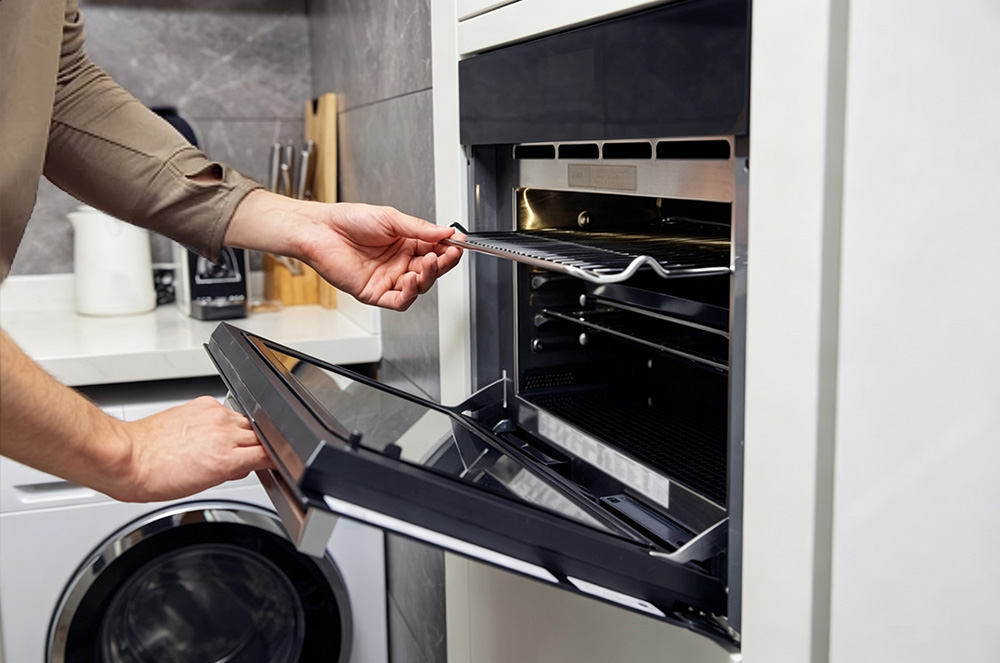
Printed glass for kitchen appliances must survive sustained heat without peeling or fading. Learn about high-temperature inks, adhesion testing, and quality verification that ensure decorative panels perform as long as the appliances themselves. Get your printing specifications reviewed today.
The Dual Challenge of Decorative Glass
Glass panels on ovens, microwaves, cooktops, and air fryers serve two roles simultaneously. They're functional — displaying controls, indicating settings, protecting internal components. And they're decorative — carrying brand colors, user interface graphics, and aesthetic finishes that define the product's look.
This dual role creates a manufacturing challenge that's easy to underestimate: the printed designs must stay intact through years of heating, cooling, cleaning, and everyday use. When ink peels, fades, or cracks, the appliance looks worn long before its mechanical components fail.
Why Standard Inks Fail in Appliance Applications
The kitchen environment is unforgiving to ordinary printing.
Temperatures inside ovens can exceed 250°C. Cooktop surfaces experience rapid thermal cycling — hot one moment, cool the next. Microwave interiors combine heat with humidity. Cleaning agents introduce chemicals that can attack ink films.
Standard screen printing inks simply can't handle these conditions. They soften at high temperatures. They lose adhesion when thermal expansion stresses the ink-glass interface. They discolor under prolonged exposure to heat and light.
The High-Temperature Ink Solution
Specialized high-temperature inks are formulated to withstand the demands of kitchen appliances. These inks, often ceramic-based or heavily cross-linked polymers, maintain their properties at temperatures up to 300°C or higher.
But high-temperature formulation alone isn't enough. The ink must also adhere strongly to the glass substrate — and that adhesion must survive thermal cycling without degradation.
The Science of Adhesion: What Makes Ink Stay Put
Adhesion isn't magic — it's the result of controlled surface preparation and precise curing.
Surface Preparation: The First Critical Step
Glass surfaces must be meticulously cleaned before printing. Any contamination — oils, dust, moisture — creates a barrier between ink and glass, compromising adhesion.
Industrial printers use cleaning systems that remove microscopic contaminants, ensuring the glass surface has the proper surface energy for ink bonding. This isn't optional — it's essential.
Curing: Where Adhesion Is Locked In
Ink doesn't simply dry on glass — it cures. Curing involves heating the printed glass to temperatures that trigger chemical reactions in the ink, creating strong bonds with the glass surface.
The curing process must be carefully controlled. Under-curing leaves adhesion incomplete. Over-curing can degrade the ink or introduce thermal stress. Experienced printers develop precise curing profiles for each ink-substrate combination.
The Role of Ink Chemistry
Different ink formulations offer different performance characteristics. Some excel at adhesion but have lower heat resistance. Others handle extreme temperatures but require careful application. The right choice depends on the specific application — oven doors need different inks than refrigerator control panels.
Testing That Validates Real-World Performance
The only way to know if printed glass will survive is to test it under conditions that mirror actual use.
Cross-Cut Adhesion Testing
The industry-standard test for ink adhesion uses a cross-cut method: a grid of cuts is made through the ink film, tape is applied and removed, and the percentage of ink remaining is evaluated.
Grade 5B (the highest rating) means no peeling whatsoever — the ink stays intact even where it's been cut into small squares.
Thermal Shock Testing
Printed glass panels must survive rapid temperature changes. Standard thermal shock tests cycle panels between cold and hot conditions — for example, -30°C to 80°C — to verify that adhesion holds and ink doesn't crack or peel.
For oven applications, more extreme tests may be required, simulating the thermal stress of opening a hot oven door in a cool kitchen.
Chemical Resistance Testing
Kitchen appliances are cleaned with various agents. Printed glass must resist degradation from alcohols, solvents, and detergents. Testing typically involves exposing printed surfaces to cleaning chemicals and verifying that the ink remains intact and unchanged.
Quality Systems That Prevent Printing Defects
Consistent printing quality requires more than good ink — it requires systematic process control.
Environment Control
Screen printing is sensitive to environmental conditions. Temperature and humidity variations affect ink viscosity, drying rates, and adhesion. Professional printing operations maintain controlled environments to eliminate these variables.
In-Process Verification
Quality isn't verified only at the end — it's monitored continuously. Operators check print quality throughout production runs, catching issues like:
Inconsistent ink coverage
Registration errors between colors
Pinholes or voids in the printed film
Contamination particles trapped in the ink
100% Final Inspection
Every printed panel should be examined before packing. Appearance checks verify color accuracy and print clarity. Adhesion and heat resistance may be tested on sample pieces from each batch.
Questions to Ask Your Glass Printer
When specifying printed glass for appliances, ask:
What temperature range is your ink rated for? The answer should match your application requirements.
How do you verify adhesion? Look for specific test methods, not vague assurances.
What's your process for surface preparation? The answer should describe actual cleaning and treatment steps, not just "we clean it."
Do you test for thermal shock resistance? This is essential for any glass that will experience temperature changes.
Can you provide test reports with shipments? Documentation builds confidence in consistent quality.